
Exosome Therapy vs Stem Cell Therapy
10
Jun
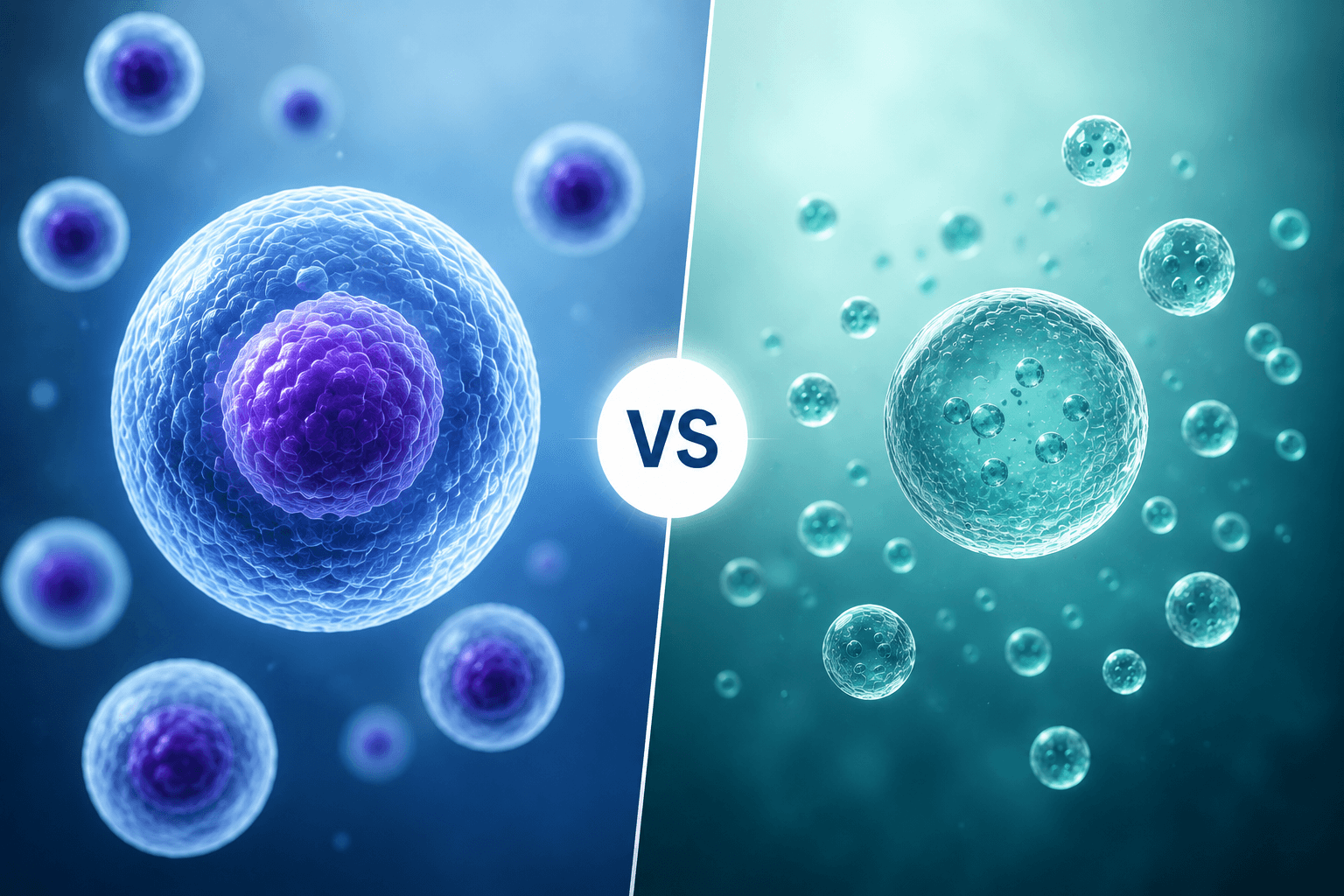
Exosome therapy and stem cell therapy are often presented within the same regenerative medicine conversation, but they are not interchangeable. One is centered on living cells with the potential to engraft, differentiate, modulate tissue environments, or produce biological signals. The other is centered on extracellular vesicles and the information they carry between cells. Both are scientifically compelling. Both are commercially visible. Both require a level of regulatory, manufacturing, and clinical discipline that is often underestimated.
The most responsible comparison does not ask which approach is more fashionable. It asks what each modality is designed to do, how it can be characterized, what evidence supports its use, how safety is controlled, and where the boundary lies between legitimate clinical development and premature commercial claims. In regenerative medicine, credibility depends less on the elegance of the concept and more on the ability to define, measure, manufacture, and clinically validate the intervention.
The core difference is biological architecture
Stem cell therapy is built around the administration of living cells. Depending on the cell type, these cells may be intended to replace damaged cells, support tissue repair, secrete therapeutic factors, regulate immune activity, or create a regenerative microenvironment. The therapy’s biological identity is therefore tied to cell source, phenotype, viability, potency, differentiation potential, and behavior after administration.
Exosome therapy, by contrast, is generally built around cell-derived vesicles. Exosomes are small extracellular vesicles released by cells and involved in intercellular communication. They may carry proteins, lipids, RNA, and other molecular signals. The therapeutic hypothesis is often that these vesicles can reproduce some beneficial signaling effects associated with cells, without administering living cells themselves.
This distinction is strategically important. Stem cells are active biological entities. Exosomes are biological messengers. A stem cell product may create effects through persistence, engraftment, differentiation, or secretion. An exosome product is expected to act through cargo delivery, signaling modulation, immune effects, or tissue microenvironment influence. Each path creates a different development logic.
The comparison between exosomes and stem cells is not a choice between old and new. It is a choice between two different biological architectures, each with its own evidence burden.
Mechanism matters more than the label
Both categories are vulnerable to overgeneralization. “Stem cell therapy” can refer to very different products: hematopoietic stem cells, mesenchymal stromal cells, induced pluripotent stem cell-derived cells, tissue-specific progenitors, or engineered cellular products. “Exosome therapy” is equally broad, because vesicle composition depends heavily on the source cell, culture conditions, isolation method, and manufacturing process.
A credible comparison must therefore begin with mechanism. What is the intervention expected to change? Is it replacing cells, reducing inflammation, supporting angiogenesis, altering fibrosis, delivering molecular cargo, or modifying immune response? Without a defined mechanism, both stem cell and exosome products risk becoming vague regenerative language rather than serious therapeutic candidates.
Mechanistic clarity also shapes endpoint strategy. If a product claims structural tissue repair, the development plan should include evidence that can detect structural or functional change. If the intended effect is immunomodulation, the program should include biomarkers and clinical endpoints that reflect immune behavior. If the effect is paracrine signaling, potency assays should align with the expected biological activity.
Product characterization is harder than marketing suggests
One of the most important differences between exosome and stem cell therapy is not conceptual, but technical. Stem cell products require characterization of living cells: identity, purity, viability, phenotype, potency, stability, sterility, genetic stability where relevant, and functional behavior. The cells may change during expansion, cryopreservation, thawing, transport, or administration. This makes process control central to product quality.
Exosome products may appear simpler because they are cell-free, but they introduce their own characterization challenges. Vesicle preparations can be heterogeneous. Their composition may vary depending on the producing cell, culture conditions, isolation technology, purification method, storage conditions, and analytical platform. Distinguishing exosomes from other extracellular vesicles, protein aggregates, impurities, or contaminants can be technically demanding.
This means that neither modality is inherently simple. A living cell product must control cellular behavior. A vesicle product must control biological cargo and preparation consistency. In both cases, the product is not just the therapeutic idea; it is the controlled material that can be manufactured, released, studied, and administered.
| Dimension | Stem cell therapy | Exosome therapy |
|---|---|---|
| Therapeutic unit | Living cells with defined identity and functional behavior. | Cell-derived extracellular vesicles carrying biological signals. |
| Primary development challenge | Controlling cell quality, viability, potency, and post-administration behavior. | Controlling vesicle identity, purity, cargo, potency, and batch consistency. |
| Potential advantage | May provide complex, dynamic biological activity in tissue environments. | May offer cell-free signaling with potentially simpler storage or delivery models. |
| Key uncertainty | Persistence, differentiation, immune response, and long-term safety. | Mechanism, cargo consistency, biodistribution, dosing, and product definition. |
| Credibility requirement | Clear cell identity, potency strategy, clinical rationale, and safety monitoring. | Robust vesicle characterization, functional assays, purity controls, and clinical evidence. |
Manufacturing defines the real comparison
The manufacturing question is where the difference between the two approaches becomes practical. Stem cell manufacturing may involve donor selection, cell isolation, expansion, differentiation, genetic modification, cryopreservation, release testing, and chain-of-identity controls. Autologous products add patient-specific complexity. Allogeneic products may offer scale advantages but require careful management of immune compatibility, donor variability, and batch strategy.
Exosome manufacturing begins with the producer cell. The quality of the vesicle product depends on how that cell line or cell source is established, cultured, stressed or stimulated, monitored, and controlled. The downstream process then needs isolation, purification, concentration, characterization, storage, and release testing. Small changes in upstream conditions may alter vesicle cargo or biological function.
For both modalities, GMP readiness is not optional. The manufacturing process must support identity, consistency, purity, potency, sterility, stability, and traceability. A product that works in an exploratory setting but cannot be manufactured reproducibly is not yet a credible therapeutic program. This is especially important because many commercial claims in the regenerative market have moved faster than standardized evidence and quality systems.
In regenerative medicine, the question is never only what the product might do. It is whether the product can be made the same way, understood the same way, and tested the same way over time.
Safety questions are different, not smaller
Exosome therapy is sometimes positioned as safer because it is cell-free. This may be a reasonable hypothesis in certain contexts, but it should not be treated as proof. Exosomes can carry biologically active cargo. They may influence immune responses, inflammation, coagulation, angiogenesis, tumor biology, or tissue signaling. Their biodistribution, clearance, dose-response profile, and long-term effects must be evaluated carefully.
Stem cell therapies raise a different safety profile. Depending on the product, concerns may include immune reaction, unwanted differentiation, ectopic tissue formation, tumorigenicity, infection, embolic risk, inappropriate persistence, or complications related to delivery. The safety strategy must reflect the cell type, route of administration, dose, patient population, and intended mechanism.
The stronger position is not to claim that one modality is universally safer. It is to define modality-specific risk and manage it through preclinical studies, manufacturing controls, clinical monitoring, and long-term follow-up where appropriate. Safety credibility comes from specificity, not assumption.
Clinical evidence remains the decisive boundary
Both exosome and stem cell therapies are surrounded by strong public interest, especially in orthopedics, dermatology, neurology, autoimmune disease, aesthetics, pulmonary conditions, and general wellness. Yet interest should not be confused with evidence. A credible therapeutic claim requires controlled clinical data in a defined indication, using a defined product, at a defined dose, delivered through a defined route, with meaningful endpoints and safety monitoring.
This is where many market-facing claims become fragile. A broad claim that “exosomes regenerate tissue” or “stem cells heal damage” is not clinically sufficient. Which tissue? Which product? Which patient population? Which endpoint? Compared to what? With what durability? Under what regulatory status? These questions determine whether the claim belongs in a scientific development program or in premature marketing.
For investors, clinicians, and health systems, the distinction is essential. A therapy may be scientifically promising and still not ready for routine clinical use. A modality may have strong future potential and still require better trials, stronger manufacturing standards, clearer dosing, and more mature safety data.
Regulatory credibility cannot be bypassed
Regenerative medicine has been particularly vulnerable to clinics offering interventions before adequate evidence, approval, or oversight. This creates reputational risk for legitimate developers and safety risk for patients. Responsible positioning must separate regulated clinical development from commercialized interventions that have not met appropriate standards.
Stem cell therapies and exosome-based products may be regulated as biological products, drugs, tissues, or advanced therapy products depending on jurisdiction, processing, intended use, and claims. Developers must understand classification, manufacturing requirements, clinical trial expectations, quality controls, labeling restrictions, and post-treatment monitoring obligations.
Regulatory credibility also shapes communication. Companies should avoid language that implies approval, proven efficacy, or broad regenerative benefit before such claims are supported. In sophisticated markets, restraint is not a weakness. It is a signal that the company understands the responsibilities attached to biological innovation.
Strategic positioning should avoid false hierarchy
It is tempting to describe exosomes as the next generation of stem cell therapy. In some scientific narratives, exosomes are framed as a way to capture the paracrine benefits of stem cells while avoiding some cellular complexities. This may be strategically appealing, but it can become misleading if it suggests that exosomes have already solved the challenges of cell therapy.
A better positioning approach is to define each modality on its own terms. Stem cells may be more appropriate where living cell function, replacement, dynamic response, or durable tissue interaction is central. Exosomes may be more appropriate where a defined signaling payload, cell-free administration, or modular biologic approach can be scientifically justified. The choice depends on disease biology, product design, delivery route, safety requirements, and evidence strategy.
For companies, this creates an important strategic discipline: do not sell the modality; sell the development logic. The strongest programs explain why a specific biological tool is the right tool for a specific clinical problem.
Credible comparison requires disciplined language
The future of regenerative medicine will likely include both cellular and cell-free approaches. Stem cell platforms will continue to evolve through engineering, differentiation control, allogeneic strategies, and improved manufacturing. Exosome programs will mature through better characterization, producer cell control, cargo understanding, potency assays, and indication-specific clinical trials.
The most credible organizations will not present either category as a universal solution. They will distinguish between research promise, clinical development, approved therapy, and commercial speculation. They will explain mechanism before outcome, product quality before marketing, and evidence before claim.
Exosome therapy and stem cell therapy should therefore be compared with precision rather than enthusiasm. Their scientific appeal is real, but credibility depends on the same fundamentals that define all serious therapeutic development: product definition, manufacturing control, safety, regulatory alignment, and clinical proof. In regenerative medicine, the responsible path is not to choose the louder promise. It is to build the better evidence.
Frequently asked questions
What is the main difference between exosome therapy and stem cell therapy?
Stem cell therapy uses living cells, while exosome therapy uses cell-derived extracellular vesicles that carry biological signals. Stem cells may act through cell behavior, differentiation, secretion, or immune modulation, while exosomes are generally studied for their signaling and cargo-mediated effects.
Is exosome therapy the same as stem cell therapy?
No. Exosomes may be produced by stem cells or other cell types, but they are not living cells. They represent a cell-free biological product category with different manufacturing, characterization, dosing, safety, and regulatory considerations.
Are exosomes safer than stem cells?
Exosomes may avoid some risks associated with administering living cells, but that does not automatically make them safe. Their biological cargo, biodistribution, immune effects, purity, dose, and long-term activity still require careful evaluation in controlled studies.
Why is product characterization important for both therapies?
Product characterization determines whether the therapy can be defined, measured, manufactured consistently, and studied reliably. For stem cells, this includes cell identity, viability, purity, and potency. For exosomes, it includes vesicle identity, cargo, purity, potency, and batch consistency.
What makes exosome development technically challenging?
Exosome development is challenging because vesicle preparations can be heterogeneous and highly dependent on producer cells, culture conditions, isolation methods, purification processes, storage, and analytical techniques. Establishing consistent identity and potency is central to credibility.
What makes stem cell therapy development challenging?
Stem cell therapy development is challenging because living cells can vary by source, processing, expansion, differentiation state, viability, and behavior after administration. Developers must manage potency, safety, immune effects, manufacturing scale, and long-term monitoring.
Can either therapy be considered proven for all regenerative uses?
No. Neither exosome therapy nor stem cell therapy should be described as broadly proven across regenerative uses. Each product must be evaluated in a specific indication, with defined manufacturing controls, dosing, route of administration, endpoints, safety monitoring, and clinical evidence.
How should investors or clinics compare these approaches?
They should compare the modalities through product definition, mechanism of action, manufacturing control, potency strategy, safety profile, regulatory status, and clinical evidence. The stronger opportunity is not the one with the more attractive label, but the one with the more disciplined development logic.
Latest Posts

Share
Quick Question