
Stem Cell Therapy for Meniscus Tears
10
Jun
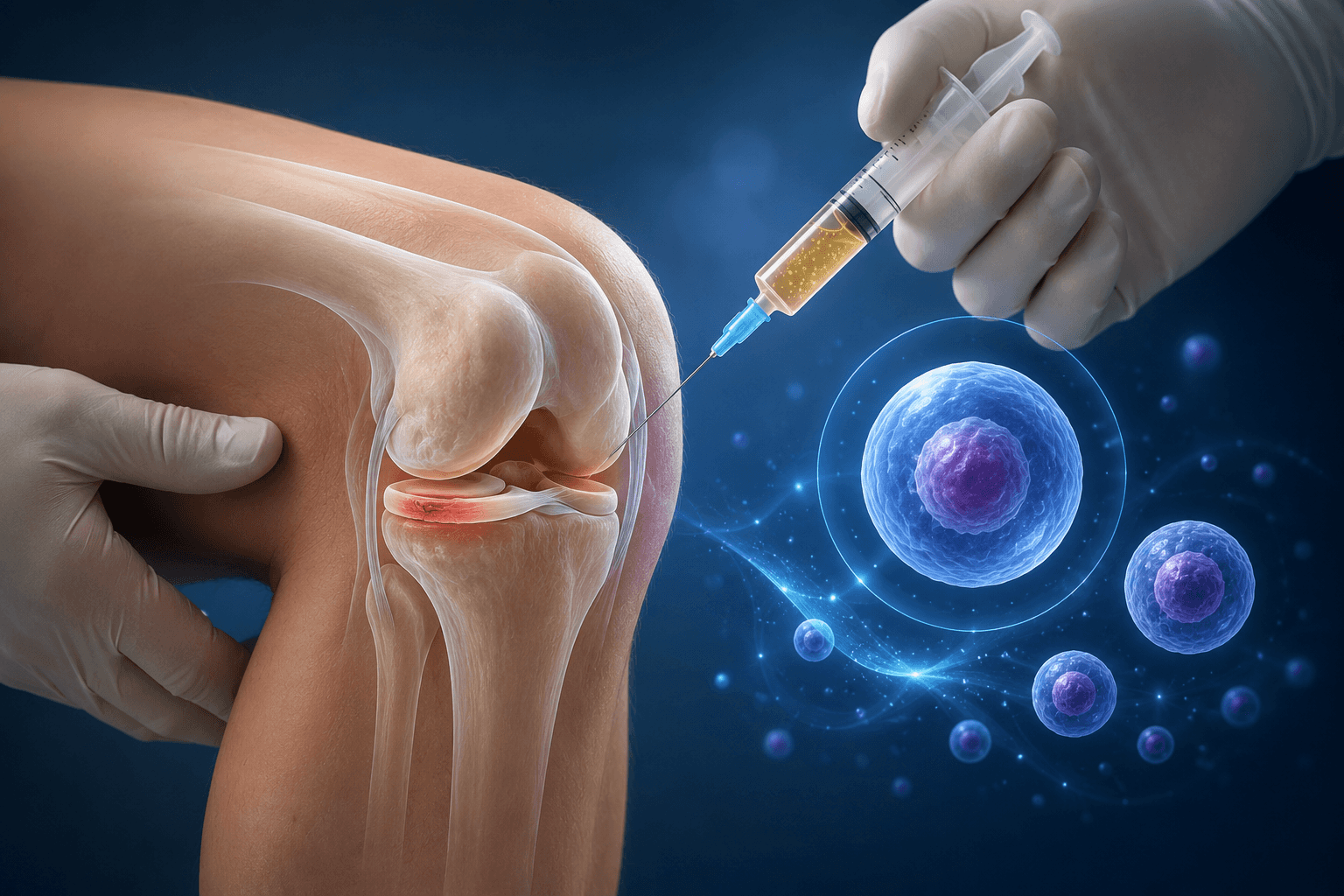
Meniscus tears are often described as cartilage injuries, but their clinical meaning is more nuanced. The meniscus is a load-sharing, shock-absorbing, stabilizing structure that helps preserve the biomechanics of the knee. When it tears, the problem is not only local tissue damage. It may involve altered joint loading, inflammation, pain, mechanical symptoms, reduced function, and, in some patients, a higher risk of degenerative joint change over time.
```Stem cell therapy for meniscus tears sits within this complexity. It is not best understood as a simple injection that “regrows cartilage.” A more responsible view is that cell-based approaches are being explored as potential tools to support meniscal healing, improve the repair environment, modulate inflammation, or enhance tissue regeneration in carefully selected settings. The credibility of the field depends on matching the biological strategy to the type of tear, the vascularity of the tissue, the mechanical stability of the knee, and the evidence required to show meaningful benefit.
The meniscus is not one uniform tissue
The meniscus has regions with different healing potential. The outer portion has better vascular supply, while the inner portion is relatively avascular. This distinction is central to treatment strategy. Tears in vascular regions may have greater potential to heal, especially when mechanically stable and appropriately repaired. Tears in avascular regions are more biologically challenging because the local environment has limited intrinsic repair capacity.
This is why a meniscus tear cannot be evaluated only by whether it exists on imaging. Tear location, pattern, size, chronicity, stability, associated ligament injury, cartilage status, alignment, age, activity level, and symptoms all influence management. A traumatic longitudinal tear in a young athlete is not the same as a degenerative complex tear in an osteoarthritic knee.
For stem cell therapy, this distinction matters profoundly. A biologic product may have a plausible role where tissue healing is possible but biologically insufficient. It is less convincing when the primary issue is mechanical instability, advanced degeneration, malalignment, or tissue loss that cannot be restored by signaling alone.
A credible regenerative strategy for the meniscus begins by respecting the tissue’s anatomy: vascular zones, mechanical load, tear pattern, and the limits of intrinsic healing.
Why stem cells are being studied
Most cell-based strategies in meniscus research involve mesenchymal stromal cells, often discussed in relation to bone marrow, adipose tissue, synovium, or allogeneic sources. These cells are generally studied for their ability to influence the local repair environment rather than simply transform into a fully formed meniscus after administration.
The scientific rationale includes several potential mechanisms. Cells may release trophic factors, modulate inflammation, support extracellular matrix production, influence chondrogenic differentiation, or interact with scaffolds designed to guide tissue formation. In some strategies, cells are used as an adjunct to meniscus repair. In others, they are explored with biomaterials, hydrogels, or tissue-engineered constructs.
The challenge is that the meniscus is a demanding tissue to regenerate. It must tolerate load, shear, compression, and complex movement. It is not enough to generate biologically active tissue; the repaired or regenerated structure must have appropriate mechanical integrity. This makes the meniscus a field where biology and engineering must be evaluated together.
The treatment context determines the evidence standard
Stem cell approaches for meniscus tears may appear in different clinical contexts, and each context requires its own logic. A stand-alone injection for a degenerative tear is different from biologic augmentation during surgical repair. A scaffold-based regenerative product is different from bone marrow aspirate concentrate used as an adjunct. These should not be presented as equivalent interventions.
| Clinical context | Possible biologic objective | Critical question |
|---|---|---|
| Acute repairable tear | Support healing after sutured repair. | Does biologic augmentation improve healing, reduce failure, or accelerate recovery? |
| Degenerative tear | Modulate inflammation and improve symptoms. | Does the intervention offer benefit beyond rehabilitation and standard care? |
| Partial meniscal loss | Support tissue preservation or scaffold integration. | Can the strategy protect joint mechanics and delay degenerative progression? |
| Meniscus repair with scaffold | Guide matrix formation and cellular organization. | Does the construct produce durable, functional tissue under load? |
| Post-meniscectomy symptoms | Reduce pain or support joint environment. | Is there measurable improvement in function, structure, or disease trajectory? |
This structure prevents overgeneralization. A positive signal in one setting does not automatically support broad use across all meniscus injuries. The field becomes more credible when each indication is tested on its own biological and clinical terms.
Product identity shapes clinical meaning
“Stem cell therapy” is not a precise product description. It may refer to bone marrow aspirate concentrate, adipose-derived preparations, culture-expanded mesenchymal stromal cells, synovial-derived cells, allogeneic products, or cells combined with scaffolds. Each has different manufacturing requirements, regulatory implications, potency questions, and safety considerations.
Bone marrow aspirate concentrate is a mixed biological preparation, not a purified stem cell product. Adipose-derived preparations can vary significantly depending on processing. Culture-expanded products may allow greater cell numbers and characterization, but they require more formal manufacturing controls. Scaffold-based strategies add another layer of product design, because the biomaterial must support cell behavior and mechanical function.
A credible program should define the cell source, processing method, cell phenotype, viability, potency strategy, sterility controls, dose, route, and release criteria. Without this definition, clinical evidence becomes difficult to interpret. Two interventions may both be described as “stem cell therapy,” yet differ so significantly that comparison is scientifically weak.
Mechanical integrity cannot be bypassed
Meniscus healing is not only a cellular event. It is a mechanical event. The tissue sits inside a joint that experiences repetitive load, rotation, compression, and shear. A biologic intervention cannot overcome an unstable tear that requires fixation, a malaligned limb that overloads the compartment, or advanced cartilage degeneration that drives persistent symptoms.
This is one of the key differences between meniscus regeneration and softer regenerative narratives. The target tissue must function under force. A therapy may reduce inflammation or pain, but that does not necessarily mean the meniscus has regenerated structurally. Imaging, arthroscopic assessment, functional outcomes, and longer-term joint preservation may all be needed to understand whether the intervention has truly altered the disease course.
The meniscus is not repaired by biology alone. It is repaired when biology, mechanics, alignment, and rehabilitation are allowed to work in the same direction.
For this reason, stem cell therapy should not be framed as a universal alternative to repair, rehabilitation, or surgical judgment. It may eventually become an adjunct in specific contexts, but its value will depend on integration with orthopedic decision-making.
Endpoints should distinguish pain relief from regeneration
One of the most important challenges in meniscus studies is endpoint selection. Pain relief is meaningful, but it does not automatically prove tissue regeneration. A patient may feel better because inflammation decreases, loading changes, rehabilitation succeeds, or symptoms fluctuate naturally. Structural healing requires a different level of evidence.
Credible studies should define what success means. Is the goal lower pain, improved function, return to sport, reduced mechanical symptoms, meniscus healing on MRI, improved repair integrity, less cartilage deterioration, or avoidance of further surgery? These outcomes overlap, but they are not identical.
Longer follow-up is particularly important. A short-term improvement may be clinically valuable, yet the meniscus field ultimately cares about durability and joint preservation. If a regenerative strategy claims to alter tissue health, the evidence should extend beyond early symptom response.
Patient selection may be the decisive variable
The patients most likely to benefit from biologic strategies may not be those with the most severe structural damage. In many regenerative fields, earlier and more biologically responsive disease states may be more suitable for intervention. For meniscus tears, this may mean repairable tears, partial injuries with preserved joint architecture, or carefully defined degenerative cases without advanced osteoarthritis.
By contrast, patients with severe malalignment, advanced cartilage loss, large unstable tears, substantial meniscal extrusion, or chronic mechanical locking may require different management. A biologic injection cannot replace the need to correct a mechanical problem when mechanical pathology is dominant.
A responsible clinical pathway should therefore begin with diagnosis and stratification. The question is not whether a patient has a meniscus tear. The question is what kind of tear, in what kind of knee, with what symptoms, and with what realistic treatment objective.
Safety and regulatory discipline remain essential
Stem cell interventions for meniscus tears should be discussed within a careful regulatory and safety framework. Patients may encounter commercial claims suggesting that cells can rebuild the meniscus, avoid surgery, or reverse degeneration. Such claims can exceed the available evidence, especially when the product is not clearly defined or formally approved for the indication.
Potential risks depend on the product and procedure. These may include infection, inflammation, pain flare, contamination, immune reaction, procedural injury, inappropriate tissue response, and unknown long-term effects. More manipulated or culture-expanded products may raise additional manufacturing and regulatory considerations. Combining cells with scaffolds or devices may create further complexity.
Responsible programs should operate under appropriate clinical governance, ethics oversight, product quality controls, informed consent, and adverse event monitoring. Patients should be told whether the intervention is investigational, approved, part of a clinical trial, or commercially offered without indication-specific approval.
Where the field can become credible
The most promising future for stem cell therapy in meniscus tears is likely to be precise rather than broad. Stronger evidence may emerge in defined repair augmentation strategies, scaffold-based tissue engineering, synovial or marrow-derived cell approaches with clear product characterization, and patient groups where biology can reasonably influence healing.
The field will need better trial design: standardized products, appropriate controls, imaging-based structural outcomes, validated knee scores, longer follow-up, tear-type stratification, and careful reporting of concomitant procedures. It will also need honest language. Symptom improvement, biological activity, structural repair, and true regeneration should not be used interchangeably.
Stem cell therapy for meniscus tears remains an investigational and evolving area of regenerative orthopedics. Its scientific rationale is meaningful, especially where healing biology is weak but repair remains possible. Its clinical value, however, will be determined by disciplined evidence rather than broad regenerative promise. The strongest opportunities will be those that define the right cell product, the right tear pattern, the right mechanical context, and the right measure of success.
Frequently asked questions
Is stem cell therapy approved for meniscus tears?
In major regulated markets, stem cell therapy for meniscus tears should generally be considered investigational unless a specific product has received formal approval for that indication. Patients should verify the regulatory status and evidence base carefully.
Can stem cells regrow a torn meniscus?
Broad claims that stem cells can regrow a torn meniscus are not supported as a universal statement. Cell-based approaches may be studied for healing support, tissue repair, or symptom improvement, but true structural regeneration requires product-specific clinical evidence.
Why is meniscus tear type important?
Tear location, pattern, size, stability, chronicity, vascular zone, and associated joint disease influence healing potential. A repairable traumatic tear and a degenerative tear in an osteoarthritic knee may require very different treatment strategies.
How might stem cells help meniscus repair?
Stem cells may support repair through paracrine signaling, inflammation modulation, extracellular matrix production, chondrogenic influence, or interaction with scaffolds. These mechanisms remain under investigation and must be linked to meaningful outcomes.
Is stem cell therapy a replacement for meniscus surgery?
Not generally. Some meniscus tears require mechanical repair or other orthopedic management. Stem cell approaches are more plausibly studied as adjuncts or investigational biologic strategies in selected cases rather than universal replacements for surgery.
What outcomes should credible meniscus studies measure?
Credible studies should measure pain, knee function, mechanical symptoms, MRI-based healing, repair integrity, return to activity, cartilage preservation, need for further surgery, durability of benefit, and safety over time.
What risks should patients consider?
Risks may include infection, inflammation, pain flare, contamination, immune reaction, procedural injury, inappropriate tissue response, and uncertain long-term effects. Risk depends on the product, processing method, dose, route, and clinical context.
What should patients ask before considering stem cell therapy for a meniscus tear?
Patients should ask what exact product is used, whether it is approved or investigational, how it is processed and tested, what evidence supports its use for their tear type, what alternatives exist, what risks are known, and how outcomes will be monitored.
Latest Posts

Share
Quick Question