
Stem Cell Therapy for Rotator Cuff Injuries
10
Jun
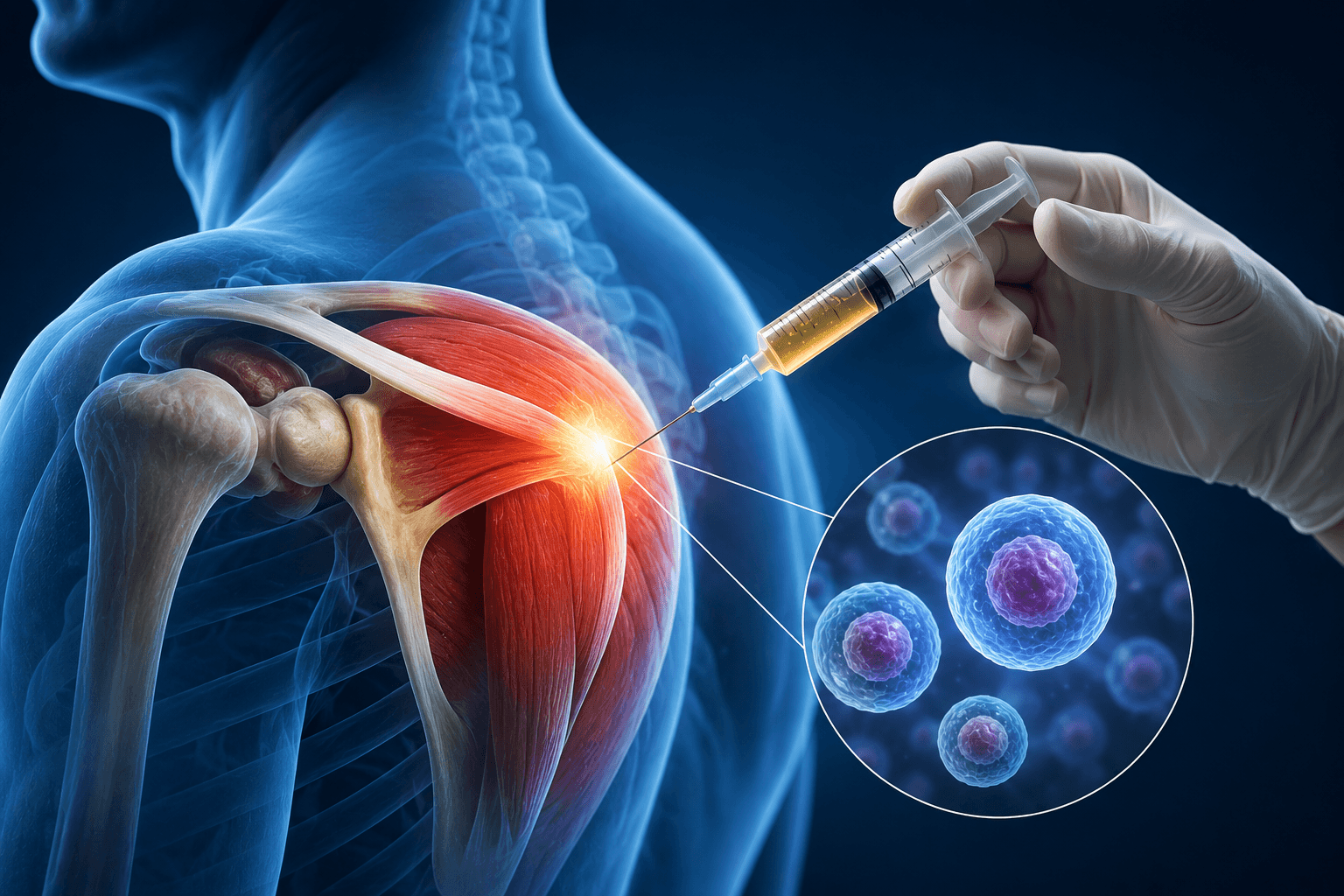
Rotator cuff injuries occupy a difficult space between mechanical failure and biological insufficiency. A tendon may tear because of trauma, degeneration, overload, poor vascularity, age-related matrix changes, or chronic impingement. Pain may improve while structural healing remains incomplete, and a technically successful repair may still face the biological challenge of restoring a durable tendon-to-bone interface.
Stem cell therapy for rotator cuff injuries is therefore best understood not as a simple alternative to surgery, but as an investigational strategy aimed at improving the biology of tendon healing. The central question is not whether cells sound regenerative. It is whether a defined cell-based product can improve repair quality, reduce retear risk, support tendon remodeling, or enhance functional recovery in carefully selected patients.
The rotator cuff is a biomechanical and biological problem
The rotator cuff is composed of tendons and muscles that stabilize the shoulder and enable controlled motion. Tears commonly involve the supraspinatus tendon, but clinically meaningful injuries often reflect a broader environment of tendon degeneration, inflammation, fatty infiltration, muscle atrophy, altered shoulder mechanics, and compromised healing capacity. This complexity is why regenerative strategies must be evaluated with precision.
A small partial-thickness tear in an active patient is not the same clinical problem as a massive chronic tear with tendon retraction and muscle degeneration. A biologic intervention may have different relevance before surgery, during surgical repair, or after a failed repair. The same term, “rotator cuff injury,” can describe very different therapeutic opportunities.
Credible development begins by defining the clinical scenario. Is the goal pain reduction, tendon quality improvement, improved tendon-to-bone healing, prevention of retear, enhanced post-operative recovery, or treatment of tendinopathy without surgery? Each objective requires a different product logic, endpoint strategy, and patient selection framework.
In rotator cuff medicine, regeneration is meaningful only when it is anchored to a specific healing problem: tendon quality, tendon-bone integration, pain, strength, function, or durability.
Why stem cells are being explored
Most stem cell approaches in rotator cuff research focus on mesenchymal stromal cells, often derived from bone marrow, adipose tissue, or other sources. These cells are not usually expected to transform directly into fully functional tendon tissue after injection. More often, the scientific rationale is based on paracrine signaling, immunomodulation, trophic factor release, angiogenic support, and influence on local tissue remodeling.
The biological appeal is clear. Rotator cuff healing requires a coordinated response involving inflammation resolution, extracellular matrix organization, collagen remodeling, vascular support, and restoration of mechanical strength. If a cell-based therapy could improve this environment, it might support better repair biology.
Yet this promise must be treated carefully. Tendon healing is slow, mechanically loaded, and structurally demanding. A product that reduces inflammation may improve symptoms without restoring tendon integrity. A product that supports matrix remodeling may still fail if the tear is mechanically unstable. Biological support cannot replace appropriate diagnosis, surgical judgment, rehabilitation, or mechanical repair when these are required.
The clinical setting defines the treatment logic
Stem cell strategies for rotator cuff injuries generally fall into several development contexts. Some are studied as injections for tendinopathy or partial-thickness tears. Others are explored as augmentation during arthroscopic rotator cuff repair. A third area involves scaffold, matrix, or tissue-engineering approaches designed to support tendon-to-bone integration.
These settings should not be combined casually. A nonoperative injection for a partial tear has a different risk-benefit profile from intraoperative biologic augmentation during repair. The evidence standard also differs. Pain relief, tendon thickness, MRI appearance, strength, retear rate, and validated shoulder scores may each matter differently depending on the intended use.
| Clinical context | Potential role of stem cells | Key evidence question |
|---|---|---|
| Rotator cuff tendinopathy | Modulating inflammation and supporting tendon matrix remodeling. | Does the intervention improve pain and function beyond rehabilitation or standard care? |
| Partial-thickness tear | Supporting tissue repair and slowing structural progression. | Is there objective improvement in tendon quality, symptoms, and durability? |
| Surgical repair augmentation | Improving tendon-to-bone healing after repair. | Does augmentation reduce retear rates or improve structural healing on imaging? |
| Massive or chronic tear | Potential adjunct to complex reconstruction strategies. | Can biology overcome poor tissue quality, retraction, and muscle degeneration? |
| Revision repair | Enhancing a compromised healing environment. | Does the therapy improve outcomes in a high-risk healing population? |
This distinction matters for investors, clinicians, and patients. A study showing symptom improvement in tendinopathy does not automatically justify use in full-thickness tears. A repair augmentation signal does not automatically support stand-alone injections. Each indication must earn its own evidence.
Product identity is central to credibility
“Stem cell therapy” is not a single intervention. It can refer to bone marrow aspirate concentrate, adipose-derived cell preparations, culture-expanded mesenchymal stromal cells, allogeneic products, autologous preparations, or cell-seeded scaffolds. These products differ in composition, processing, cell concentration, potency, sterility controls, regulatory status, and clinical behavior.
Bone marrow aspirate concentrate may contain a small fraction of progenitor-like cells along with platelets, cytokines, immune cells, and plasma components. Adipose-derived preparations may contain stromal vascular fraction or culture-expanded cells depending on processing. Allogeneic products may offer consistency and scale, but introduce donor-related and immune considerations. These distinctions are not technical footnotes; they shape the entire development path.
A credible program should define what is being administered, how it is manufactured, how potency is assessed, how sterility is assured, and what release criteria are used. Without product definition, clinical outcomes become difficult to interpret. If one clinic uses a same-day preparation and another uses an expanded cell product, they should not be discussed as though they are equivalent.
The tendon-to-bone interface is the strategic target
For surgically repaired rotator cuff tears, the tendon-to-bone interface is a central biological challenge. Native enthesis tissue has a complex transition from tendon to fibrocartilage to mineralized fibrocartilage to bone. After repair, healing often occurs through scar-like tissue that may not fully recreate the original structure. This can contribute to retear risk, particularly in large or degenerative tears.
Stem cell augmentation is therefore often positioned around improving this interface. The ideal biologic strategy would support organized matrix formation, collagen alignment, controlled inflammation, vascular remodeling, and mechanical integration. In practice, this is difficult to prove. Imaging may show tendon integrity, but not necessarily restoration of native enthesis architecture. Functional scores may improve despite incomplete structural healing.
This is why endpoint design is essential. A serious development program should connect biological intent to measurable outcomes. MRI or ultrasound integrity, tendon thickness, retear rate, pain scores, range of motion, strength, validated shoulder function scores, and return-to-activity metrics may all contribute to the evidence package.
The highest-value question is not whether cells can be placed near a repaired tendon. It is whether they change the quality, durability, and clinical meaning of healing.
Patient selection may determine success
Rotator cuff outcomes are influenced by age, tear size, chronicity, tendon retraction, fatty infiltration, smoking, diabetes, metabolic health, bone quality, activity level, rehabilitation adherence, and surgical technique. A biologic intervention may appear ineffective if tested in a population where mechanical or degenerative limitations dominate. Conversely, a carefully selected population may reveal a more interpretable signal.
This makes patient selection one of the most important design questions. Stem cell approaches may be more plausible in patients with partial tears, early degenerative changes, high-risk healing profiles, or repairable tears where biologic support can meaningfully influence outcome. They may be less plausible in cases where tendon tissue is severely retracted, muscle quality is poor, or the mechanical problem cannot be corrected.
Selection should also consider realistic goals. Some patients seek pain relief. Others want return to sport, avoidance of surgery, or improved healing after repair. These are different outcomes. A responsible clinical pathway should match the intervention to the patient’s pathology and expectations.
Safety and regulation require disciplined communication
Cell-based interventions for shoulder conditions should be approached with regulatory and clinical caution. Patients may encounter commercial messaging that implies stem cells can regenerate torn tendons or avoid surgery broadly. Such claims can exceed the available evidence and create unrealistic expectations.
Safety risks depend on the product and procedure. They may include infection, inflammation, pain flare, contamination, immune reaction, procedural injury, inappropriate tissue effects, and unknown long-term consequences. Culture-expanded products, donor-derived products, manipulated cells, and combination approaches may carry additional regulatory and quality requirements.
The responsible standard is straightforward: claims should match evidence, and interventions should be used within appropriate regulatory, ethical, and clinical frameworks. Patients should understand whether a therapy is approved, investigational, part of a clinical trial, or offered as an unproven commercial procedure.
Where the field may become stronger
The future of stem cell therapy for rotator cuff injuries will likely depend on more precise clinical trial design. The field needs clearly defined products, standardized processing, adequate controls, longer follow-up, imaging-based structural outcomes, validated functional measures, and careful stratification by tear type and patient risk factors.
It may also evolve toward combination strategies. Stem cells or stromal cell-derived products may be paired with scaffolds, growth factors, extracellular vesicles, improved suture constructs, rehabilitation protocols, or biologically informed surgical techniques. The most credible approaches will not rely on cells alone as a universal solution, but will integrate biology with mechanical repair and patient-specific care.
For now, stem cell therapy for rotator cuff injuries should be positioned as a developing area of regenerative orthopedics rather than a settled standard. The scientific rationale is real, particularly around tendon healing and repair augmentation. The clinical opportunity is meaningful. But credibility will depend on careful product definition, controlled evidence, honest communication, and a clear distinction between investigational promise and proven routine care.
Frequently asked questions
Is stem cell therapy approved for rotator cuff injuries?
In major regulated markets, stem cell therapy for rotator cuff injuries should generally be considered investigational unless a specific product has received formal approval for that indication. Patients should verify regulatory status before considering any procedure.
Can stem cells heal a torn rotator cuff?
Stem cells are being studied for their potential to support tendon repair biology, but broad claims that they can heal torn rotator cuffs are not appropriate without product-specific clinical evidence. Tear size, chronicity, tendon quality, and mechanical stability all influence healing.
How might stem cells help rotator cuff repair?
Stem cells may support healing through paracrine signaling, immunomodulation, trophic factor release, matrix remodeling, and influence on the tendon-to-bone interface. These mechanisms remain under investigation and must be linked to measurable clinical outcomes.
Is stem cell therapy a replacement for rotator cuff surgery?
Not usually. Some rotator cuff tears require mechanical repair, especially larger full-thickness tears or functionally significant injuries. Stem cell approaches are more often studied as nonoperative biologic strategies or as augmentation during surgical repair.
What types of stem cell products are used in rotator cuff research?
Research may involve bone marrow aspirate concentrate, adipose-derived preparations, mesenchymal stromal cells, allogeneic products, or cell-based scaffold approaches. These are different products and should not be treated as interchangeable.
What outcomes should credible rotator cuff studies measure?
Credible studies should measure pain, shoulder function, strength, range of motion, imaging-based tendon integrity, retear rates, return to activity, durability of benefit, and safety. Structural and patient-centered outcomes should be interpreted together.
Latest Posts
Share
Quick Question